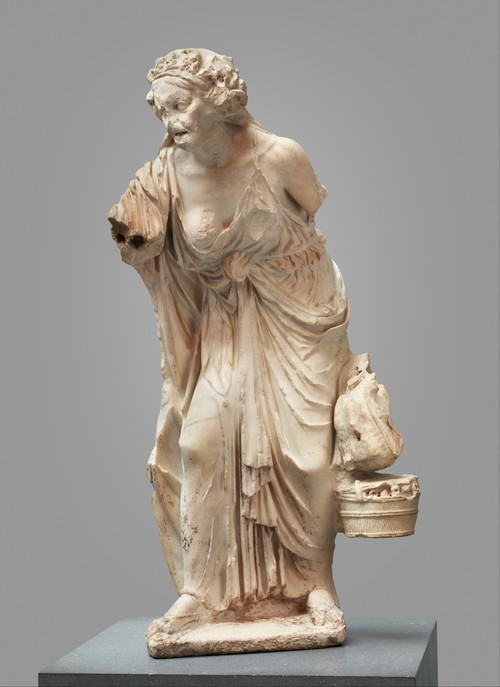
Marble statue of an old woman, Roman, A.D. 14–68, but based on a work of the second century B.C. Metropolitan Museum of Art, New York, acc. no. 09.39
(Photograph: The Metropolitan Museum of Art, Rogers Fund, 1909, www.metmuseum.org)
Marble statue of an old woman, Roman, A.D. 14–68, but based on a work of the second century B.C. Metropolitan Museum of Art, New York, acc. no. 09.39
(Photograph: The Metropolitan Museum of Art, Rogers Fund, 1909, www.metmuseum.org)
Virtual Byvanck Lecture 2020: Beyond Classical Art: A Lecture on the Diversity of Greek and Roman Sculpture
by Caroline Vout
When we think of ‘classical art’, we think of nudity, naturalism, shiny white marble. But neither ‘classical art’, nor the beauty, purity and virtue that we associate with it, are obvious. Rather, they have accrued over time.
This lecture focuses on what ‘classical art’ omits, on unexceptional but important sculptures that challenge our vocabularies and ask for new frameworks. In privileging sculpture, we are again being selective. But it is sculpture that has dictated our artistic engagement with the Greeks and Romans, and sculpture that is, therefore, best placed to usher in a new chapter.
This is not only about extending Greek and Roman sculpture’s remit to include the ‘ugly’, ‘aniconic’, ‘demotic’, colour; it is about reassessing its interactions with ‘foreign’ traditions (the Egyptian, Eastern, Indian etc). Where does ‘classical art’ sit between the local and global, and in the midst of the archaeological? Does ‘classical art’ have a future?